Camp Widow
By Karen Stiller
The day after our wedding, Brent and I sat in a departure lounge at Toronto’s Pearson Airport packed with enough kissing, fondling, giggling couples to fill a plane headed to Jamaica. Married in Halifax the day before, we spent our wedding night in a hotel where we came very close, for a cool-headed couple, to spending most of the cash for our trip ($200) on the airport hotel white robes in which we floated around our room.
The robes felt so special because we felt so special.
At the airport, we saw there were, in fact, many other chirping lovebirds lifted by the same warm wind we believed carried us alone. It surprised us we were not the only couple in the world to marry during the third week of June 1990. Now, we were all gathered together to fly off to the long defunct Trelawny Beach Hotel Resort.
We’re not alone in the sun. We’re not alone in the rain.
Thirty-three years later, in the days after Brent died, when I believed I was the saddest person I had ever met, I learned through social media that Al Fleming had also died during that achingly cold January when ice storms clenched Ottawa down into something terrible.
I didn’t know Al or his wife Beth, but I knew of them. I knew they had attended the church my husband pastored (had pastored) in downtown Ottawa but left a couple of years before we arrived. I understood that Al’s death, like Brent’s, had swooped out of the sky like a hawk and snatched him away from the people who loved him who stood mouths open, eyes wide, trying to pull that man back to earth.
Once again, my surprise at how normal we were, after all.
A few weeks after that, I contacted Beth over Facebook. “I know this is a strange message. We have so many mutual friends, and it appears we lost our husbands around the same time. I’m so sorry for your loss. This is a strange new place we are both in. Would you like to talk sometime?”
After that began a long exchange of mutual consolation, book recommendations, and failed attempts at coffee, full of silent weeks and strung out over months. As it turned out, we wrote to each other from only a few city blocks away where our houses sat like dens we crawled into to hide that long winter.
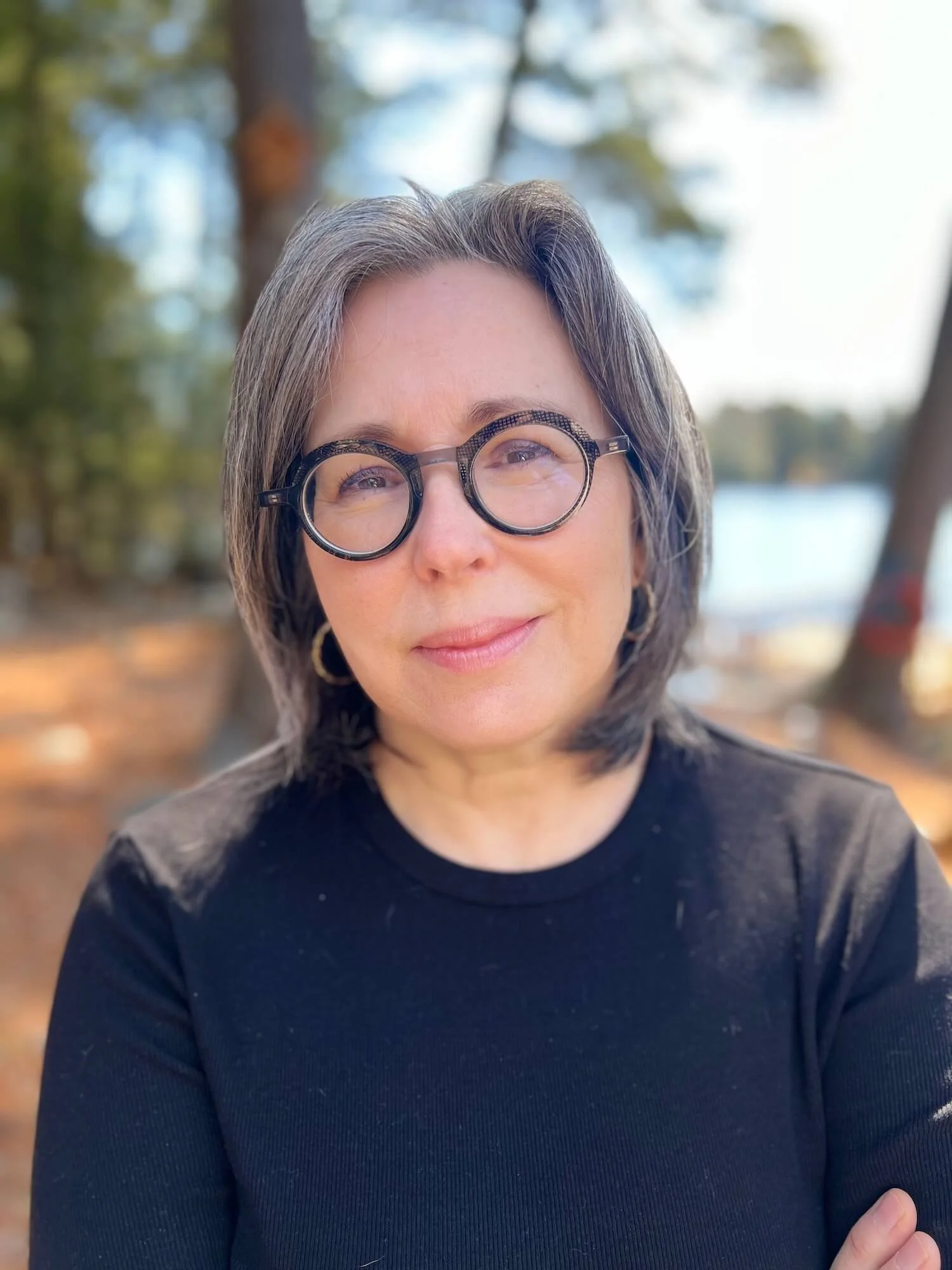
Beth and I finally had a long face-to-face conversation at another funeral of another husband, this one even younger. We decided she would need us. A small club was born, which was a clutch, an island, a relief. It even had cute names. As a pack, we called ourselves the Wids. Faye, the newest, would be Young Widow. Beth, who had not lost the softness of her heart: Kind Widow. And me? Bossy Widow, because I like to tell people what makes sense for them to do.

On a Tuesday night, we had a meeting of the Wids at Young Widow’s house. She was the one with young children who needed her at home. We filled our plates with chicken kabobs, tzatziki, and salad from the foil containers of Greek take-out Faye ordered in and laid out on her counter. “We’re having our meeting. Go read,” she’d say to the kids, who we could tell were pleased to see us there. I usually brought candy.
I had a stunningly stupid thing to share that night, which someone had said to me, a real doozy. But it’s foggy to me now because Beth’s dumb story eclipsed mine. We were speechless in its shadow.
Beth explained that Al used to talk about the Bible and matters of faith with a friend of Beth’s, a woman with whom he often respectfully disagreed. When Al died, the well-intentioned woman said: “Well, now Al knows the earth is flat.”
Silence.
Then: “What did you say back?” I asked Beth.
“I just laughed and laughed,” she said. And so we did too.
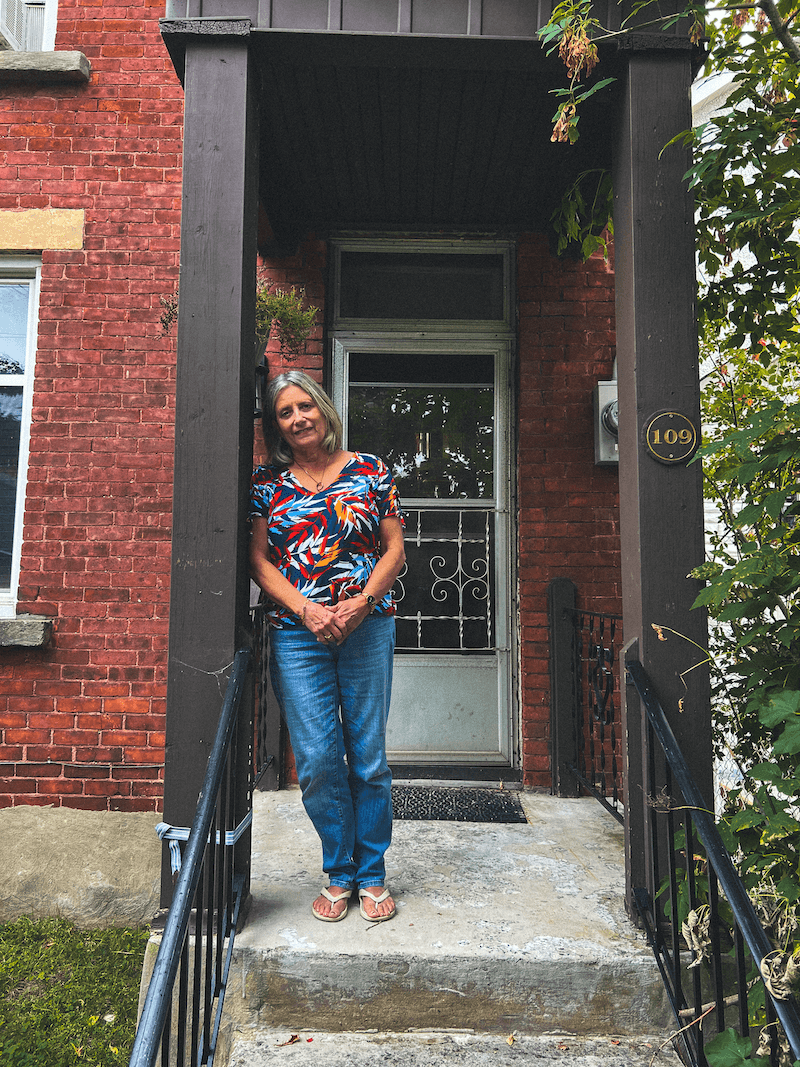
This is what Kind Widow says about this kind of thing: “A lot of the stupid comments come from an effort to make you feel better. And you can’t make anybody feel better when they’ve had a loss like that. We’re uncomfortable with sadness, and uncomfortable seeing people we care about miserable, so I understand it’s well-intentioned. People just don’t know what to say in the face of death.”
Beth said she could go back and see moments when she had been just as ridiculous. So can I.
As a young pastor’s wife in 2001, a fifty-five-year old man in our church died of brain cancer. His death demolished his wife. For weeks after, I burst into tears when I saw her at church. As if somehow the loss was mine. In a tiny way every loss is all of ours, but even I thought that my tears were a bit much. Did Adrienne really need a damp hug from me every Sunday? Also, Brent had bought me a beautiful black leather jacket with the funeral cheque – which is an extra shot of cash into a clergy household, like a big tip left after a good meal.
It took me a few years before I could wear it to church. What if Adrienne complimented me on my jacket and I blurted out the awful truth?
Instead, one Sunday, with my even-then-bossy wisdom, I said: “Just think, heaven is so great that even if Eric could come back, he wouldn’t.”
Since Brent died, also of brain cancer, I have tried to find Adrienne, to say I am so sorry. So far, my search has led me only as far as Eric’s obituary where I read what I had forgotten, that Brent was with him when he died.
Alan Baxter Fleming liked to watch his wife dance. This included when they led worship together at their church. Al played bass. Beth stood in front of him and sang with the band.
“He said he liked to watch my butt wiggle, and you know, that kind of thing.”
Al loved music. His bookcases were stuffed with a vast collection of books on rock and roll. He collected hundreds of albums and for years co-hosted a show on CFRA radio called Middle Aged Bald Guys (Talking Rock and Roll).
Many evenings after work, the couple ate supper and then moved into their living room to listen to music. Al would sit on the couch and pick the tunes. Sometimes, Beth would get up and dance because they both loved it when she did. This appreciation of her moves felt new for Beth. When she danced at weddings, she saw there were photos and videos being taken, she just didn’t make it into them.
Beth believes this is because of her reckless abandon.
Al also liked those quiet evenings because he had a big government job working with senators based on Parliament Hill, the sprawling, gothic style buildings that anchor Wellington Street in Ottawa. Just down the hill from the Hill sits the church where Beth was a secretary and Al was a parishioner and Brent would, eventually, be a priest. Beth and Al met there. They had both been married to other people before, with different levels of disappointment and disaster.
To a question of his, Beth emailed Al. “Dear Mr. Fleming. Yes, we do have a Christmas Eve service. Here are the times…”
Church business led to coffee dates, led to rainbow sprinkle donuts from Tim Horton’s in small paper bags thumbtacked anonymously to the church office bulletin board, led to bacon and eggs at a diner after early mid-week services, led to holding hands, led to kisses, which led to Al breaking into spontaneous prayer because he was so grateful.
All of this led to a wedding and a kind of joy that neither had ever felt.
“It was magnetic,” says Beth. “I just felt devoted, and I knew he was devoted to me. But it wasn't blind devotion, because we knew each other so well.
We knew that we were lovable in each other's eyes.”
In our eyes, there are rods and cones. They are the cells that turn light into sight. Rods and cones are located on the more widely known part of our eyes that is the retina. Beth’s eyes are missing the cones. She was born with only the rods and is legally blind, a reality she describes as a complicating factor in her life.
Beth started out as a Campus Crusade missionary who arrived from California, to Ottawa, via Alberta and other twists and turns. Now, she is an administrative assistant in Young Widow’s law firm, but the city still holds unknown pockets for her.
Al proudly hailed as Ottawa born and raised. A rare bird in a city of politicians, diplomats and students coming and going. He knew inside and out the canal, the river and the parks, the one way streets, gritty Centretown where we all lived, the statues of the suffragettes where tourists linger, China Town and Little Italy.
“I used to phone Al and say, ‘Honey, I'm standing on a street corner, and I don’t know where I am.’”
Al would say: “Honey, what's across the street?”
With all the light available to her, Beth described what she could see.
“Then he’d say: ‘Okay, now just turn right.’ It was the darndest thing. He was my map.”
Al her map. Beth his north star. “Always Beth first” was Al’s motto, in marriage, in life, and in his death.
That January, in the last days of his living, before they knew Al’s kidneys were failing, before he called out “Help me Beth,” as they wheeled him down that long hall, before family and friends sat in the hospital waiting room after Beth’s urgent calls, and before they stood around his bed and sang “Amazing Grace,” Al lay in his own bed at home where they both believed he would feel better soon. Beth bustled around their bedroom preparing to go to the market to buy food her husband would find enticing enough to eat.
Al caught Beth’s eye and said: “You’re pretty.”
“It was the sweetest thing. And I didn't stop and appreciate it. I wish I had just really stopped, you know?”
I do know.
Regret appears frequently in the support groups for the grieving Beth now leads for the Bereaved Families of Ottawa (BFO). First, after Al died, Beth tried a more spiritual and churchy kind of group for herself. But some of the platitudes weren’t helpful, nor the mixed nature of the group. I had the exact same experience. Too much rushing to the finish line of all is well. People who lost elderly parents mixed in with people who lost their spouses or their children, or maybe even their cats.
Then Beth attended a BFO group, sat in a circle of chairs in a community centre meeting room, and found it so helpful she wanted to volunteer.
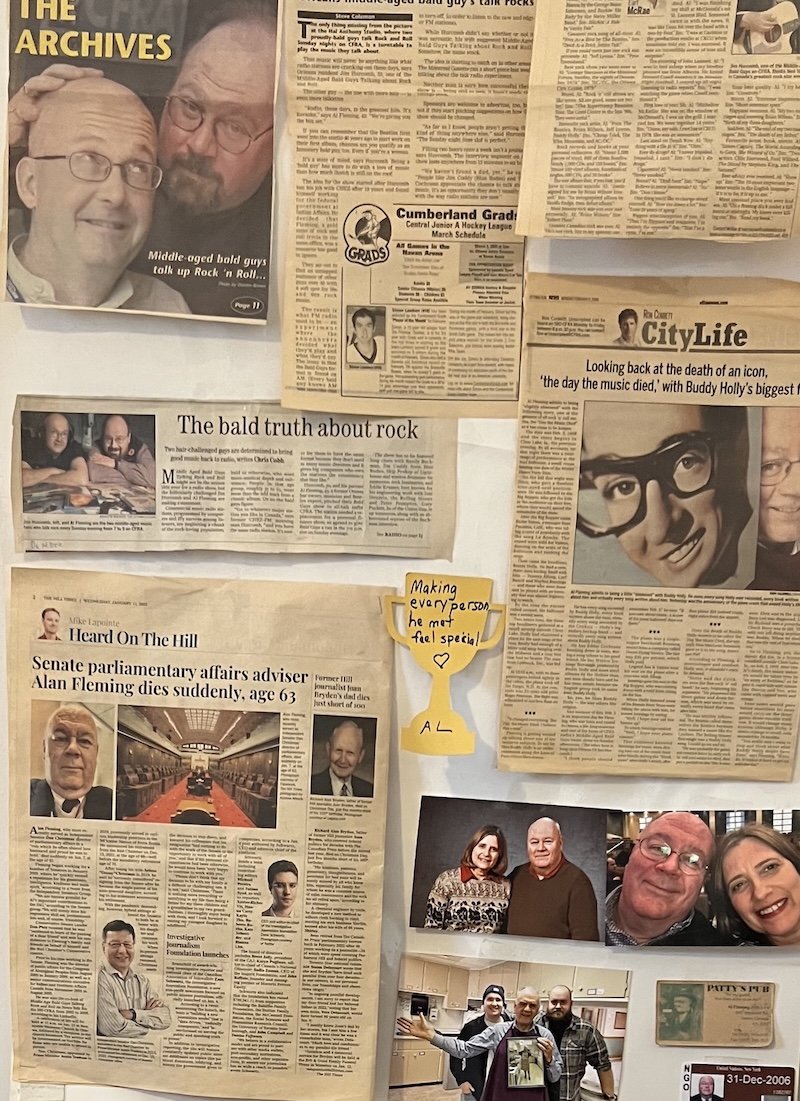
Now, when Beth leads a group, she holds up a poster board on which she has taped newspaper clippings about Al. This is a show and tell exercise about the lost, to help others see and understand. Eventually, everyone has a turn. On Beth’s poster there are several pieces about Al’s radio show. There’s an article with his reflections on the day Buddy Holly died, and a full page story with this headline: “Senate Parliamentary Affairs Advisor Alan Fleming Dies Suddenly, Age 63.” Beth passes around a framed 5x7 of her and Al, just married at the church where they met, beaming.
Everyone listens. Everyone applauds. Some people cry along with whoever is sharing. Grief is a connector.
“That’s the great thing about being in a group where we all have the same loss experience,” said Beth. “We feel the beauty of the love the couple shared.”
God doesn’t come up as often as one might think. “I feel like I’m off the hook. I don’t have to have the spiritual answers, which is good because I’m not the Answer Man anymore. I’m upset with who I used to be, if I think about the platitudes I used to share with people who were hurting,” Beth said. “I feel God in my ability to survive, and I feel I am walking by faith now more than ever, because so many things are hard to accept.”
This is a sacred space, said Beth, because of what happens there. “People are so vulnerable. They are the walking wounded. They can be honest. And I feel so privileged that this is the space where they decide to do it.”
Beth quotes Al quoting Mr. Rogers:
“Look for the helpers.”
On the second night of my first ever Camp Widow, I texted my 87-year old father a picture of me with my new camp friends, wearing an avocado hat attached with Velcro beneath my chin. My face stuck out as the pit. The photo booth with funny hats and other props was part of the gala that anchored the retreat for widows and widowers held in a fancy-ish hotel in downtown Toronto.
The workshops and talks carried titles like “Beyond Grief: Practical Steps to Reclaim Your Life After Loss” and “Can Grief be a Superpower?” But it was the Saturday night party that Camp Widow threw for a ballroom full of sad sacks that set it apart.
“Dad, I think I’m going to be okay,” I wrote, because I knew his worry for me was an ocean. It had been ten months since Brent had died, and I was in the thick deeps, sometimes still trying to believe it was true. It helped me being around people who had lost their spouses and hearing they had made it.
Understanding I could still wear an avocado hat helped me too.
Camp Widow was one of the first things I was bossy about when the Wids first met.
“Come with me,” I said, when I went a second time. Beth said yes.
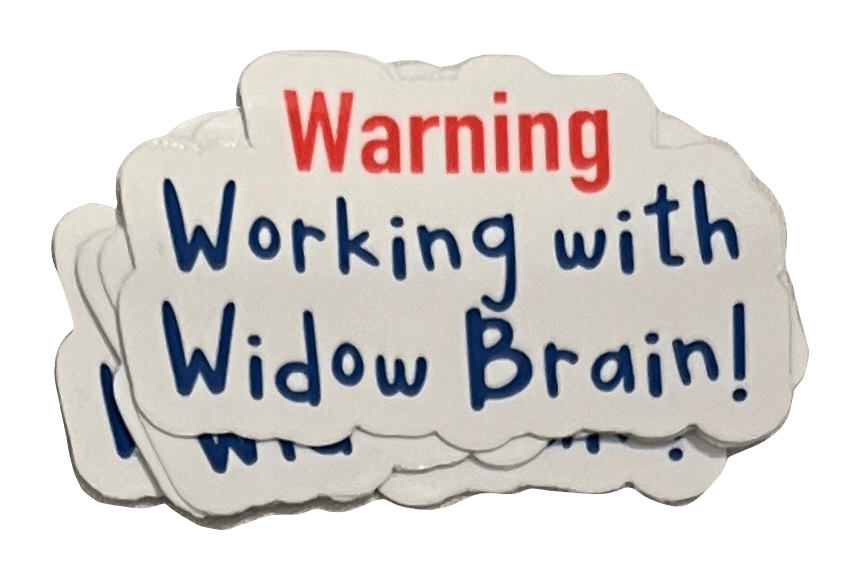
A conference for widows is weird. Merch tables sell t-shirts that say things like “Perseverance” and “Widowed Warrior.” There are “Widowed Badass” pins which my daughter ordered me to remove from my backpack the second she spotted it. Boxes of worry rocks sit on the same table as vibrators.
I bought a black winter toque with the word Hope across the front in bright blue letters. Swept away, I also bought the widowed warrior shirt, which felt silly outside of the conference. I wear it for yard work.
If nothing else, I wanted Beth to experience Saturday night.
The helpers who attend – all widowed – lead a memorial exercise. That night with Beth, there were small paper trophies cut from gold paper at each of our places. We were invited to write down wonderful things about our person. Before the trophies were pinned to a wall covered in black fabric, they were read out loud so everyone could cheer.
People cry, of course. Then they have a party. The lights dim. The music and dancing begin.
Beth and I sat at our round table, chatting about what the conference had been like, and if she would come back a second time like I had.
“Probably not,” she said. Not everyone does.
We smiled as we watched the dancing. There were sequins and suits, sneakers and heels, and all manner of contorting. Clearly, especially for those whose loss was recent, there had not been much zipping oneself into something snazzy and dancing to “Thriller” for quite a while.
That’s when Beth leaned over and told me how much Al loved to watch her dance.
“You like to dance?” I asked.
“I love to dance.”
The unmistakable first notes of “Dancing Queen” filled the room. A non-crying cry rose up from the dance floor.
“Let’s go,” I said. We danced and danced, and for a few moments, we were queens.