The Uncommon Gift
by Sara Billups
We were walking 100 km of St. Olav’s Way, the northernmost pilgrimage in the world. The group was mostly made up of people from our church back in Seattle, including my sister-in-law and my 16-year-old kid before his junior year, the clip picking up to college.
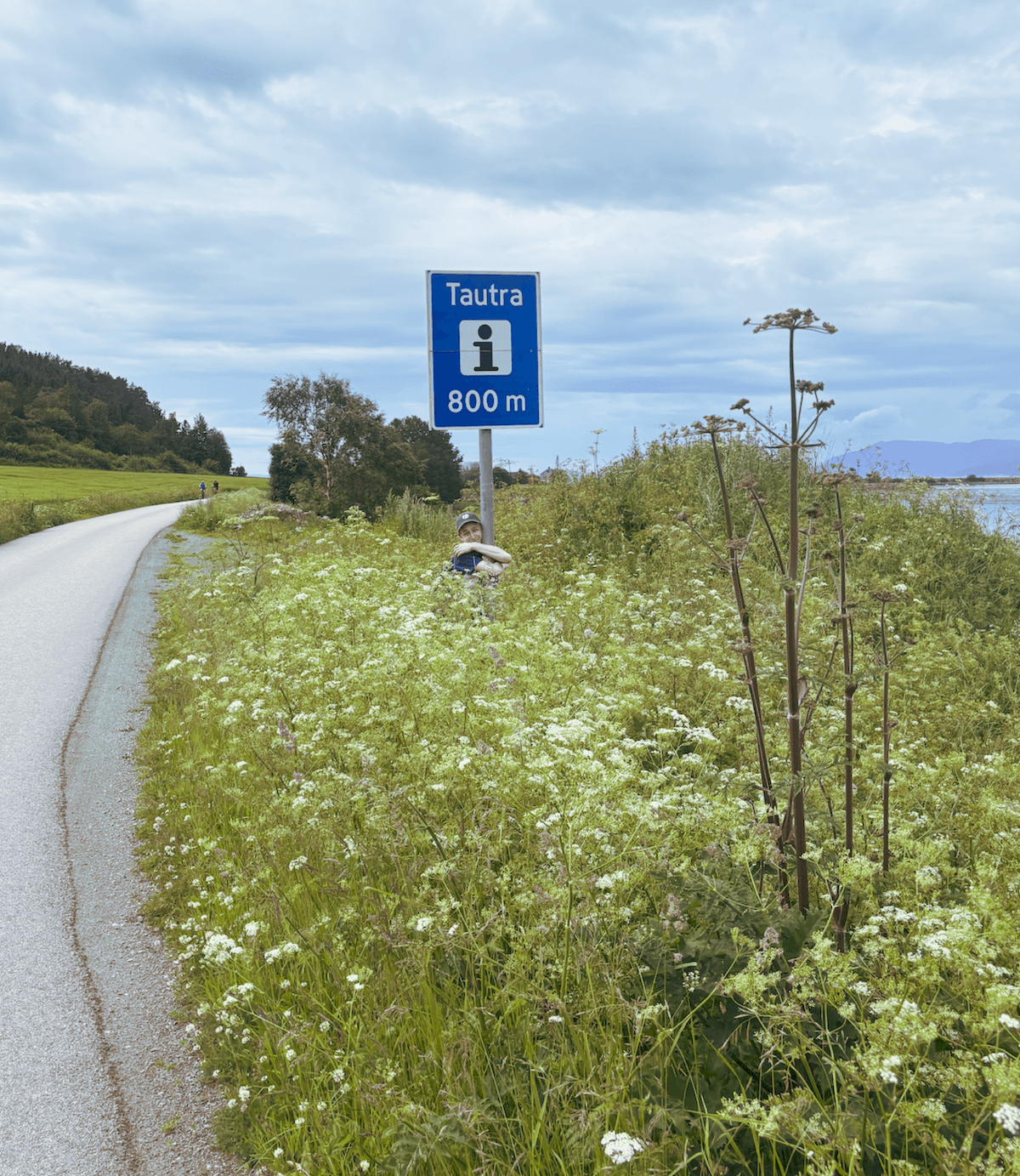
Each day for five days, we walked about 20 kilometers. The hardcore “Camino pilgrims” were already planning next year in Ireland. I did not catch the pilgrimage bug. That week, and my career as a long-distance walker, would end by crossing a 2.3 km causeway between Frosta and Tautra, delivering us to a farm-brewery-inn where we would meet Randy. We were trying to get to the nuns on the island. To the monastery on Tautra, and maybe to thick bread and dark beer. But everyone knew we were trying to get to Randy.
My mother died five months before the trip. I’d hoped some emotional wringing out would happen as I walked. If not returning to Seattle with a general sense of her presence, her still being somewhere out there, then with a better metabolization of my own emotional wear and tear. Yet I did not feel a thing about my late mother all week. No reflections in my journal, no tears. Until we got to Tautra, when something else happened entirely.
Something completely true.
Everybody collapsed in the courtyard on Tautra. I mean, we caved. Fifteen pairs of spaghetti legs, probably dehydrated, badly in need of showers. Empty water bladders and walking sticks tossed in a pile next to the beer garden table. Then Randy arrived in a tucked blue t-shirt, fresh from a week with the island nuns. Randy and his wife Carolyn, both in their 70s, had planned to walk St. Olav’s with all of us. A nasty case of plantar fasciitis changed their plans.
And I actually mean Randy meticulously pre-planned the walk. I am a person who cannot think about tomorrow until the night before at best. In the months before the trip, our St. Olav’s Way WhatsApp group chat was mainly populated by Randy’s annotated notes on train timetables and airport transfer options.
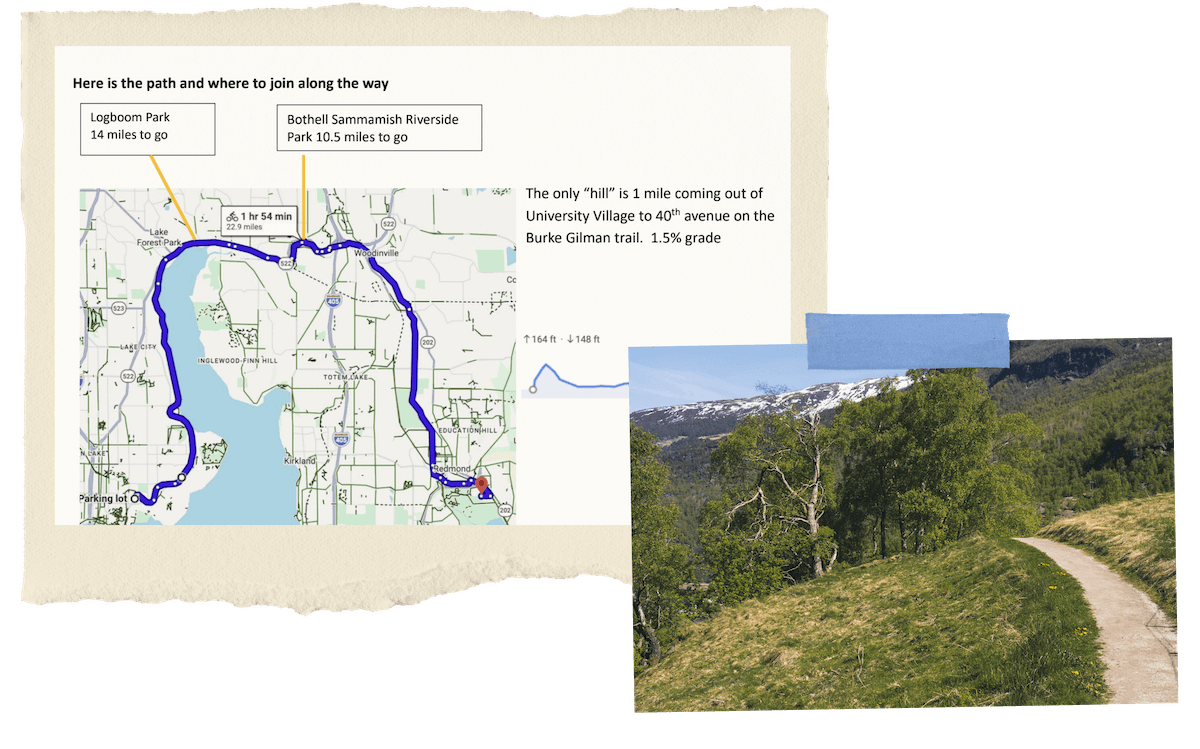
Before they decided to try walking 100 km, Randy and Carolyn got into biking. They got stuck in France during quarantine, where they had enrolled in language school. They liked riding bikes back and forth to French class and getting fresh air for the legally allotted hour of outdoor time each day. Soon after moving to Seattle later that year, Randy began organizing weekend bike trips for members of our church. The rides continued this past summer, with Randy’s annotated routes and highlighted maps emailed to the church listserv each week. For a long ride looping the northern portion of Seattle, Randy instructed the group to meet at the Victoria’s Secret at University Village. His email, precisely:
10:00 am start from outside Victoria's Secret. See details.
Flat
Let me know
If you have been to the outdoor mall near the University of Washington campus, you know it is located on a clearly marked corner with broad sidewalks. There is room for a lot of cyclists to gather outside of the Victoria’s Secret. The choice to meet there and not outside the less-illicit window display of, say, Gap or Ann Taylor, was perfectly natural. Victoria’s Secret was chosen without irony or a second thought. I loved this.
I loved Randy’s precise, practical mind.

Kenya
Randy is an academic and trained physician. He spent his career in toxicology and pediatric emergency medicine in cities across the United States and in Africa, including a year in rural Kenya in the mid-1980s, where he became the sole physician for an area with 50,000 people. When he left St. Louis for Kenya, Randy had never been beyond the United States, outside of a trip to Canada.
Randy started delivering babies in Kenya in 1985, the year after AIDS arrived in East Africa. The new epidemic was highly stigmatized, spreading in equal numbers between men and women, while simultaneously blazing across West and Central Africa. In 1985, I went to a Fort Wayne, Indiana, library as an elementary school student and researched AIDS for a book report. Researchers understood that the virus was transmitted by blood, from mother to child, but a lot was still unknown. Randy delivered babies almost daily.
“Were you afraid of getting sick?” I asked.
“You just go,” Randy said.
I did not understand the impulse. I realized that I could have asked Randy the same question, were you afraid, forward, backward, and upside down, and Randy would have delivered the same version of “you just go.” I asked again, anyway. “You just make your choice, you know?” he told me. I didn’t know. That was before Randy told me about the snakes, three kinds of venomous species on their property. In the morning, neighbors would often say “hello” and then, “I caught another one.” Shortly after they moved in, someone caught a deadly black mamba in the kitchen of the house next door.
Later, in another African context, Randy worked for a few months in a large urban hospital. Each day, 400 children came for help. Randy and his colleague admitted 50 or 60 young patients each day. Two to four children who were admitted died every day. Death, the awful death of a still new person, was constant and expected.
Randy learned two things from those experiences: First, if he did not rest, even in the presence of constant death, his body and mind would not function, and he would be of no help to anyone. He took a sabbath each week, even when his partner said, “Children are dying because you take the day off.” Second, he would return to Africa. Randy made his choice. The next time, he would move to a city, training physicians instead of treating patients. His hands would never be able to deliver enough new life to cover the constant young death of children. He couldn’t have known what complications city life would bring in the years ahead.
Mariakloster
On Tautra, I read facts about the island monastery, Mariakloster, in a colorful laminated booklet with more attention than I normally pay to tour brochures. Bone relics of saints, including Benedict, were placed at the altar by a bishop when the church was dedicated in the mid-aughts.
The wooden and slate structure looks like an eco farm education center from the outside. The greenhouse-inspired chapel design is surrounded by roses, berries, evergreen. The nuns’ private residence looks like a modern Scandinavian dream house. An Architectural Digest cover story.
When the nuns garden, their kale is greener. They winter harder, pruning very red apples as snow dusts the island. In an apocalypse, I imagine we all go to the nuns at Mariakloster on Tautra. All of us, everyone. They feed us. There is always more than enough. During meals, the sisters sit on the same side of a long table, spaced apart in what looks like a relic of social distancing. They eat in silence, chew in silence, looking at the fjord. In older days, members of the order would sign as a way to communicate, using their own language.
Inside the chapel, exposed intricate beams throw shadows on each other, on the walls, on the sisters in prayer. The resurrection cross above on the altar has no corpus, the booklet explains.
“The arms of the cross are hollowed out so they have no end and can embrace the whole world.”
Belgian carpenters built the beech wood choir stalls where the sisters sit, designed with swirled lines that look like Viking ship bows. Sisters at sea.
The eight nuns sing Norwegian liturgy or speak Gregorian chant during the seven times they meet each day in the chapel. Their “hours” begin at 4:15am (Lauds) and end with Compline at 9:00pm. Randy joined for each service that week, keeping time with the rhythm of the sisters.
Bujumbura
Randy and Carolyn moved to Burundi in 2014. Two months later, Randy was surprised to be appointed Dean at a medical school. At the time, Randy said there were nine surgeons in the country, all based around the capital Bujumbura. 300 doctors served the entire population of eleven million people.
“You don’t know this, but we actually lived through an attempted coup in Burundi. With gunfire and rocket grenades,” Randy said. I ask him to tell me, that I’d like to learn about what he experienced.
I’d heard about Rwanda, but I’d wager like many peers, I knew relatively little about similar ethnic struggles in neighboring countries. Randy began with a very brief history: In contrast to the better-known 100 days of genocide in Rwanda in 1994, there was a genocide in Burundi in 1972, resulting in at least 100,000 deaths, then in 1993 following a democratic election and assassination of the new president, a coup attempt led to twelve years of civil war.
A year after Randy and Carolyn landed in Bujumbura, tension built until the 2003 peace accord unraveled. When the party announced that then President Pierre Nkurunziza would run for a third term, the opposition began protests that became violent. Several neighborhoods in the city became opposition strongholds.
As days went by, the situation became more palpably tense. Randy heard gunfire most days. Residents built neighborhood barricades using whatever they could find: downed telephone poles, large rocks, tree stumps. Opposition factions were burning mattresses and tires in the streets. On a couple of occasions while driving to work, Randy had to show his stethoscope to pass a barricade and arrive at the hospital. I imagined Randy, steady, raising one palm away from the wheel and lifting the stethoscope with the other.
Randy and Carolyn were hosting a guest in town from Seattle, a professor, who they had to drive to the airport around active fire and nearly unpassable roads. “The prof was white as a sheet,” Randy said. A violent two-day attempted coup came five days later.
“Did you think about leaving?” I asked, swapping myself with the white-as-a-sheet prof. “We didn’t think a lot about leaving,” he said. “We had to work. You also hear about being the frog in the kettle. We probably had some aspect of that. We had an emergency plan, and we went from green to yellow to orange. We never got to red. If we had, there would have been no choice but to leave.”
Instead, Randy and Carolyn lived their normal life, going on errands during the day, to the bank and grocery store. For some time, they stopped going to restaurants because there was a higher threat of attacks in public spaces.
Once, getting ready for church, Randy and Carolyn heard a giant explosion, which they later learned was the assassination of a government member who was also head of the Internal Security forces. They went to church anyway, a congregation made up of a couple hundred people with members of both sides of the ethnic divide in Burundi and international folks. Talk about working across the aisle and across severe, violent differences.
Searching for some lesson for 2026 America, I asked Randy what he learned from his time in Burundi, from sitting with people on different sides. “My landlord was from one side, and my boss at the university was from the other side. And I met with them in both of their offices, listening to their stories of persecution and the killing of relatives by the ‘other side’, sitting with them as they cried.” The pain was not his, but Randy could sit, look both men in the eye, and see common humanity.
Mariakloster
The St. Olav pilgrims meet Randy for Vespers. First, per his WhatsApp request, we gather at a building next door to watch an informational Mariakloster video adjacent to the sisters’ herbal soap and creams shop with samples we could try (bestseller: cucumber/avocado balm). Instead of Vespers, I wanted to go to Compline that evening but the timing conflicted with our farewell-pilgrimage-dark-beer-thick-bread dinner back at the inn. At Compline, Randy said the sisters use a metal brush to sprinkle holy water onto the congregation for silent blessing and sleep protection.
We take our seats at Vespers, and the eight sisters emerge from a side door. I am suddenly hit with a rush of feeling. One of them has the exact jawline of my mother.
I had not cried once on the trip about her passing. I expected emotion during the walk and it had not come. But with this, the sweep of a turning jawline from a stranger-nun, the tears begin to swell and burn. This sister walks with the others to the Viking ship choir pew, wearing white cowls sewn in one piece. There is no opening like a robe. “This means literally that the sister cannot ‘go out’ of monastic life,” I read in the laminated pamphlet.
“A symbol of a life totally wrapped up in God.”
Randy joined us in the blond pews. We pilgrims sat and stood at the appointed times together while the nuns sang. I did not need to look at the sister-mom again. My tears did not stop. I cried the length of the service, silently, hair covering my face. The perceived anonymity allowed the grief of losing her, five months before, to finally surface. I welcomed the tears. The tears, as I quickly wiped them away, smelled like cucumber and avocado.
At the farewell pilgrimage dinner following Vespers, my sister-in-law Lori pulled me aside. The craziest thing had happened, she said. During the service, Lori saw a clear vision of my mother seated in the row in front of her. My mom, in this vision, turned around and looked at my sister-in-law with a huge smile.
As Lori told me this, she realized my mother was sitting in the row right in front of her. In the same row as me and my son. I could not stop crying restorative tears during Vespers. And my mother was right next to me.
Seattle
When we got back to Seattle, I told this to Randy, who was nonplussed. Curious how he would react to something unexplainable, I asked if he had seen anything miraculous, a vision or healing. Yes, Randy has seen two people miraculously healed. One, a newborn with a mass that spanned the length of his chest, which disappeared two days later after the child was prayed over. The other, a woman with a brain bleed that immediately stopped after a group prayed. A scan confirmed her head was perfectly normal.
“My mom died of a brain bleed,” I reminded Randy, even though I knew he knew. A week or two after she died, Randy met with us to explain what had happened to her body from a physician’s perspective. We needed someone to speak to us medically. Randy told us what happens after the first bleed, precisely. Blood vessels compress, making repeated bleeds much easier to occur.
We could have held up my mother by her drooping shoulders, her body broken from advanced Parkinson’s disease. We could have looped her around us and carried her seventy-eight pounds on our backs to prevent her from hitting her head again. Still, she would have lost balance and found a way to fall. Randy freed us from the enormity of false guilt, the belief that there was something more we could have done.
Randy is the rare kind of person who can do that: accept the reality of illness and the possibility of healing. He has seen awful early death and the relief of death from prolonged illness. Prayers for healing answered and unanswered.
Randy did story work at Mariakloster. Scanning his life, he wrote about how God worked from his baptism as a child. He wrote about his grandparents’ church, the bus to Sunday School at age six. From there to Kenya, the Midwest, Burundi, France, Seattle. Many places led him to Tautra. That week, Randy wrote what he called “a love letter from the Holy Spirit,” telling him how God had held him from the beginning, all the way through his life. I would not naturally use language like “love letter from the Holy Spirit.” I thought about this for a while, and I appreciated Randy even more. Here is a person who is highly practical and exceedingly tender.
A person, I now see, who has the uncommon gift of presence.
He simply keeps going.